
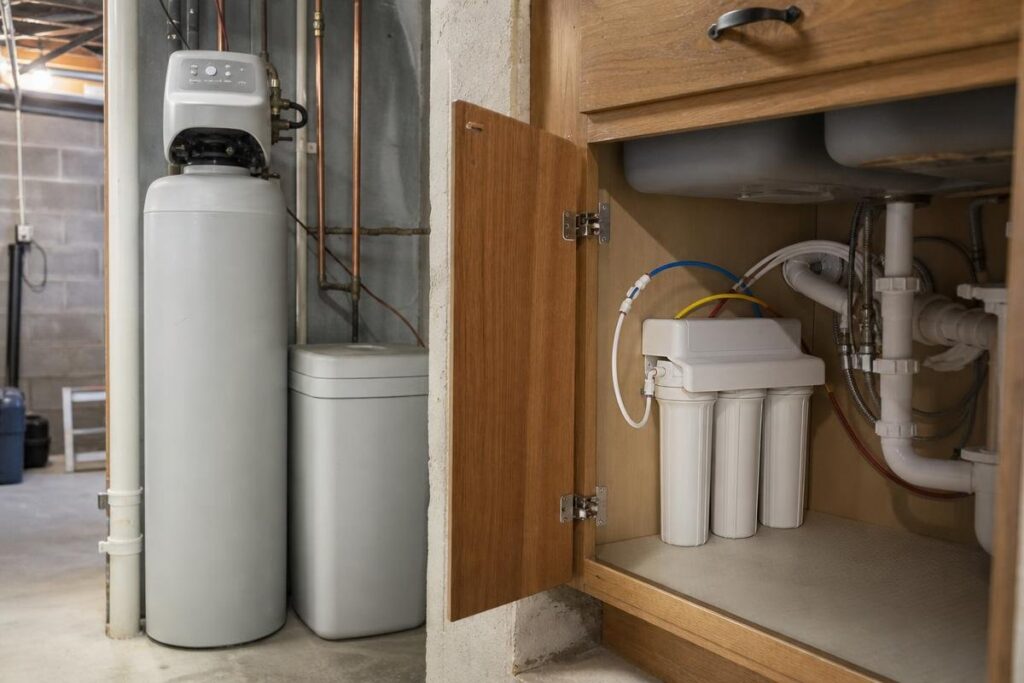
St. Paul tap water runs between 12 and 20 grains per gallon of hardness, well above the level where your pipes, water heater, and appliances start taking a beating. That’s why so many homeowners here ask us about the water softener vs. water filter question. The honest answer is that these two systems do very different jobs, and which one your home needs depends on what’s actually in your water. Our licensed plumbers have spent years in basements across this city sorting out exactly that, and we’re happy to walk you through it.
Not sure what your water needs? We can help you find the right fix for your home.
Key Takeaways
- Water softeners remove hardness minerals like calcium and magnesium; water filters remove contaminants like chloramines, sediment, and PFAS.
- St. Paul water hardness regularly exceeds 12 grains per gallon, making softening a practical concern for most homes here.
- Knowing which system addresses your specific water problem helps you avoid paying for one you don’t need.
- Many homes in this area benefit from both systems working together, especially older homes with aging pipes.
Your dishes come out of the dishwasher cloudy with white spots. Your skin feels dry and tight after a shower. Maybe there’s a faint chemical smell when you run the tap. These are real problems in Twin Cities homes, and they don’t all have the same fix.
That’s the core question here: do I need a water softener, a water filter, or both? It’s a common question, and the answer depends on what’s actually in your water. Generic national advice won’t cut it. Water coming out of your tap in the metro has its own specific profile, and the right system for a home in Frogtown may look different than advice written for a city in Arizona or Georgia.
Water softeners and water filters serve different purposes. Local water conditions and your home’s needs determine which system fits best. By the end, you’ll have a clear picture of what your water needs, not a sales pitch.
What Does a Water Softener Actually Do?
A water softener does one thing, and it does it well. It targets hard water, which is water that carries high levels of dissolved calcium and magnesium minerals picked up as groundwater and river source water move through rock and soil.
St. Paul tap water commonly tests between 12 and 20 grains per gallon (gpg) of hardness. Anything above 7 gpg is considered hard enough to cause real damage. That means many homes in the metro may be dealing with water hardness that can contribute to scale buildup and reduced appliance efficiency over time.
How Ion Exchange Removes Hardness Minerals
Salt-based softeners work through a process called ion exchange. Water passes through a resin tank filled with tiny beads. Those beads swap calcium and magnesium ions for sodium ions. The hardness minerals stay behind in the tank. Soft water flows to your faucets.
The result is water that stops leaving scale on your pipes, water heater, dishwasher, and fixtures. Scale buildup is the slow killer of appliances. Soft water extends their life. If you notice white crusty deposits on your showerheads or faucets, those are early signs of hardness at work and the damage is already in progress.
What a Water Softener Does NOT Remove
This is where a lot of homeowners get tripped up. A softener does not filter your water. It does not remove chloramines (the disinfectant used in local municipal treatment), sediment, bacteria, lead, nitrates, or PFAS compounds.
Soft water is not the same as clean water.
If your concern is what is actually in your water, not just how hard it is, a softener alone will not solve that. That is exactly what the next section covers.
Wondering how hard your water really is? Schedule a water quality test and get a precise reading before you buy anything.
What Does a Water Filter Do?
A water filter is designed to remove contaminants from your water supply, not to address hardness. That distinction matters. Filters can target specific contaminants depending on the type of system and its certification. A properly selected filter can reduce specific contaminants, depending on its certified performance. They do not make it soft.
Types of Filtration Systems: Whole-House vs. Point-of-Use
A whole-house filter, also called a point-of-entry system, connects to your main water line. Every tap in your home gets treated water. These are a solid fit for whole-house water filtration systems, especially in older neighborhoods like Frogtown where aging pipes can add sediment or metallic taste to your water.
Point-of-use filters treat water at a single tap. Under-sink units, countertop filters, and pitcher filters all fall into this category. Reverse osmosis systems can reduce a range of contaminants when the system is appropriately certified. Check your local water-quality report and the product certification for the contaminants you want to address.
One local detail worth knowing: the water supply here uses chloramines as a disinfectant, not plain chlorine. Standard carbon filters rated only for chlorine may not fully address chloramines. That chemical taste or smell you notice from your tap? Chloramines are often the reason. Make sure any filter you buy is rated for chloramine reduction.
What a Water Filter Does NOT Remove
A standard whole-house carbon filter does not remove hardness minerals. Calcium and magnesium pass right through. Your filtration system may be pulling out chloramines and sediment while still leaving scale to build up inside your pipes and appliances.
Filtered water is not the same as soft water.
If you are noticing both a chemical taste and scale buildup on your fixtures, you may be dealing with two separate problems that need two separate fixes. That is a conversation worth having with a plumber who knows local water conditions.
Water Softener vs. Water Filter: A Side-by-Side Comparison
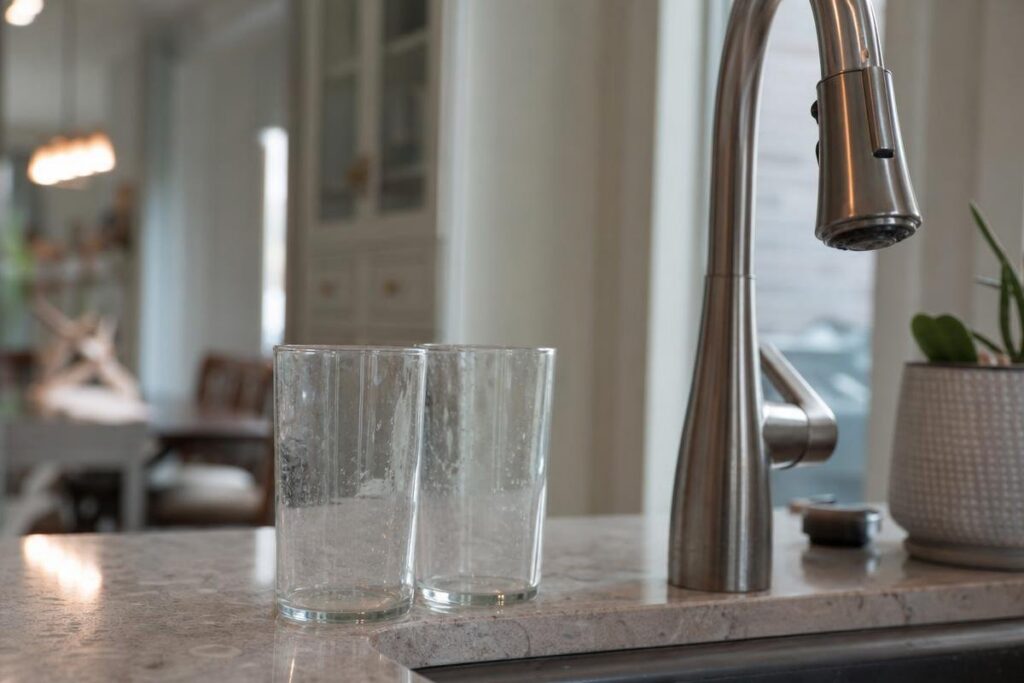
A water softener and a water filter are not the same thing, and they solve different problems. Here is a direct comparison so you can see exactly what each system does and does not do.
|
Feature |
Water Softener |
Water Filter
|
|---|---|---|
|
Primary purpose |
Remove hardness minerals (calcium, magnesium) |
Reduce specific contaminants based on filter type and certification |
|
Method |
Ion exchange |
Activated carbon, reverse osmosis, or UV |
|
Improves taste and odor |
No |
Yes |
|
Prevents scale buildup |
Yes |
No |
|
Removes PFAS or heavy metals |
No |
May reduce some contaminants with appropriately certified filtration |
|
Ongoing maintenance |
Salt refills every 4 to 8 weeks |
Filter cartridge replacement every 3 to 12 months |
|
Best for |
Scale, water spots, dry skin, appliance protection |
Taste, odor, chemical safety |
Local water hardness typically runs 12 to 20 grains per gallon, so scale is the most common complaint, but chloramine disinfection means taste and odor concerns are real too. If your main issue is white buildup on fixtures and shortened appliance life, a softener is the right tool. If you are worried about chemical safety or your water tastes off, a filter, especially a reverse osmosis system, is the answer. You can also check out signs your home has hard water if you are not sure which problem you are dealing with.
What St. Paul Water Quality Actually Looks Like
Your tap water here comes from the Mississippi River. Saint Paul Regional Water Services (SPRWS) treats it before it reaches your home, but treatment doesn’t mean soft or chemical-free. If you’ve ever noticed scale building up on your faucets or a faint chemical smell from the tap, that’s not your imagination. That’s what this water actually does.
Hard Water in the Twin Cities: The Numbers
Local tap water typically tests between 12 and 20 grains per gallon (gpg) of hardness, depending on the season and how SPRWS blends its source water. For reference, water is considered hard at 7 gpg. Most homes here are running at nearly double that threshold, sometimes more.
That hardness level means mineral scale is constantly building up inside your pipes, your dishwasher, and your water heater. Scale acts like insulation inside a water heater tank, forcing the unit to work harder and wear out faster. If you’re hearing rumbling or popping from your tank, that’s often scale at work. Our post on why your water heater is making noise covers exactly what’s happening and what to do about it.
Neighborhoods like Payne-Phalen, the West Side, and Summit-University also have a higher share of older galvanized and copper pipes, which makes hard water even harder on your plumbing. Treatment for a home with this hardness profile isn’t a luxury. It’s practical protection.
Chlorine, Chloramines, and What Comes Out of Your Tap
SPRWS doesn’t use plain chlorine to disinfect your water. They use chloramines, a combination of chlorine and ammonia. Chloramines are more stable than chlorine alone, which helps them stay active through miles of distribution pipe. The tradeoff is that they’re harder to remove at home.
A standard carbon filter rated for chlorine may not fully remove chloramines. If you notice a chemical smell or taste from your tap, or if you keep a fish tank and need to treat your tap water before adding it, chloramines are likely the cause. A whole-house carbon filter rated specifically for chloramine removal, or a reverse osmosis (RO) system at the kitchen tap, handles this effectively.
PFAS contamination is a documented concern in the East Metro, where communities near legacy 3M disposal sites in Washington County, including Lake Elmo, Oakdale, and Woodbury, have had PFAS detected in their water supplies. The risk varies by location and is worth a conversation, not panic. An RO system is the most effective residential option for PFAS removal if you have specific concerns about your water quality.
Not sure what’s actually in your tap water? Get a free softener assessment and let our team walk you through whole-house filtration and softening options built for local water.
Do You Need Both a Water Softener and a Water Filter?
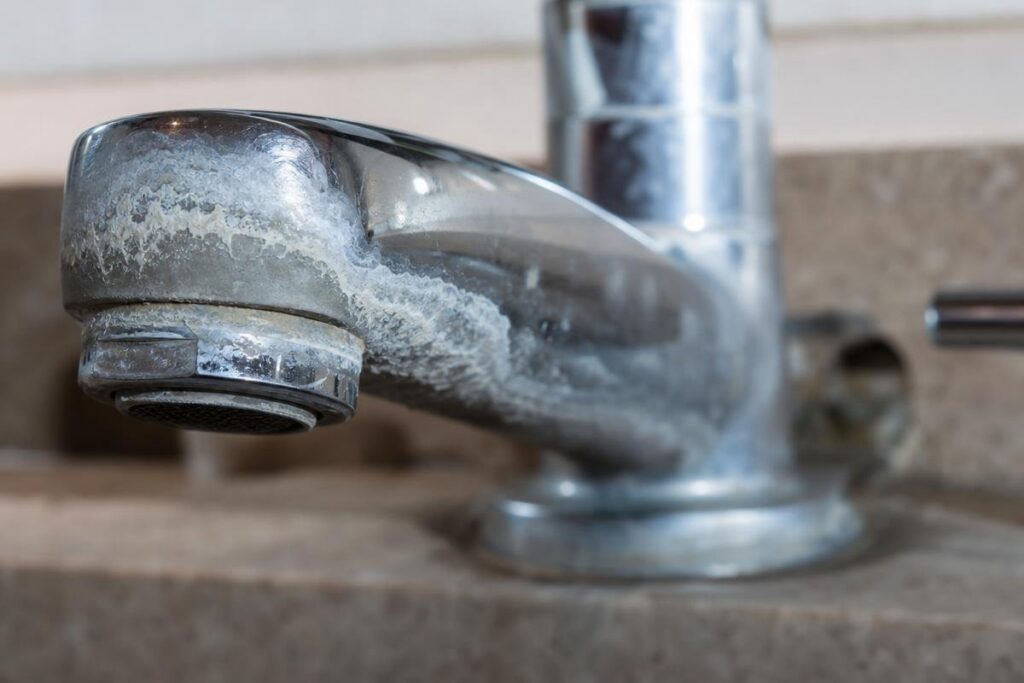
Most homeowners in the metro area do not need both systems. But some absolutely do. The right answer depends on what your water is actually doing to your home and your health.
When a Softener Alone Is Enough
If your main complaints are scale buildup on faucets, spotted dishes, stiff laundry, or dry skin after showering, a softener is likely all you need. Municipal water here meets EPA safety standards, so if you have no taste, odor, or contaminant concerns, a softener handles the most common hard water treatment problem we see across this area. If you are still deciding on the right equipment, our guide on choosing a water softener for your St. Paul home walks through the key questions.
When a Filter Alone Is Enough
This situation is less common here, but it does happen. If your home is newer construction, you are not seeing scale damage, and your water hardness tests below 7 grains per gallon, a filter may be all you need. Renters or homeowners whose main concern is taste, odor, or chloramine residue from municipal treatment fall into this category.
Some homeowners also ask about PFAS, given the detections in the East Metro noted above. If that is your concern, a reverse osmosis filter is the right conversation to have, not a softener.
When St. Paul Homes Benefit from Both
Older homes are where we most often recommend both systems. Homes in Frogtown, Dayton’s Bluff, and other neighborhoods with aging galvanized or copper pipes face two separate problems. Hard water accelerates scale buildup inside those older pipes, and the pipes themselves can leach sediment or metals into your water. A softener slows the scale accumulation. A filter catches what the pipes are already releasing.
If your home was built before 1970 and you have never had your pipes checked, that is worth knowing before you invest in either system. Our team has been in enough basements across this city to know that older pipe materials change the equation fast.
Salt-Free Water Conditioners: A Third Option Worth Knowing
You may have heard about salt-free water conditioners, sometimes called descalers or template-assisted crystallization systems. They do not remove hardness minerals like calcium and magnesium. Instead, they change the structure of those minerals so they are less likely to stick to your pipes and appliances as scale.
The appeal is real. No sodium gets added to your water, and no salt discharge goes into the environment. That matters if you are on a low-sodium diet or if your municipality restricts salt-based softeners.
Here is the honest tradeoff. Conditioners are generally less effective once hardness climbs above 15 to 20 grains per gallon. Water across the metro regularly hits that range. You also will not get the slippery feel of traditionally softened water. And a conditioner is not a filter, so it does nothing to remove contaminants like chloramines or sediment.
For most homes in this area with hardness above 15 gpg, a traditional salt-based softener outperforms a conditioner. If you have specific health or environmental concerns, a conditioner is worth discussing with a water treatment professional. Choosing the right plumbing services in St. Paul partner can help you sort through the options before you buy.
Frequently Asked Questions
Is tap water in the area safe to drink without a filter?
Yes. Saint Paul Regional Water Services meets all EPA Safe Drinking Water Act standards and publishes an annual water quality report you can read online. That said, safe and great-tasting are not the same thing. Chloramines used in the treatment process can leave a chemical taste or smell. If your water tastes off, a carbon filter or reverse osmosis system at the kitchen tap fixes that.
How do I know if my home has hard water?
Look for white crusty buildup on your faucets and showerheads, spots on dishes right out of the dishwasher, soap that barely lathers, or dry itchy skin after a shower. Water in this area typically tests between 12 and 20 grains per gallon, which is well above the level where scale starts damaging your pipes and appliances. A simple test kit from any hardware store gives you a precise reading in minutes. You can also check out 9 signs your St. Paul home has hard water for a more complete picture of what to watch for.
Will a water softener make my water taste better?
No, not really. Softeners are designed to remove hardness minerals, not to improve taste or remove chloramines. Some homeowners notice a faint salty quality in softened water, though most people do not. If taste is your main concern, a carbon filter or RO system at the kitchen sink is the right tool for that job.
What is the difference between a water softener and a reverse osmosis system?
A water softener treats all the water entering your home through ion exchange, targeting hardness minerals only. A reverse osmosis system filters water through a semi-permeable membrane at a single tap and removes a much wider range of contaminants, including PFAS, nitrates, lead, and chloramines. RO systems produce a smaller volume of filtered water and are not built to handle whole-house hardness on their own. Many homeowners use both: a softener for the whole house and an RO unit at the kitchen tap for drinking and cooking water.
What does installation cost?
Costs vary based on the system type, your home’s size, and your water quality results. Getting an accurate number really does require a licensed plumber to look at your water and your plumbing before quoting anything. McQuillan Home Services LLC is located at 1727 MN-36, St Paul, MN 55109. Contact us to set up a time, or reach out through our email at [email protected].
Will a water softener protect my water heater and appliances?
Yes, and this is one of the strongest arguments for softening. Hard water scale builds up inside water heaters, on heating elements, and inside dishwashers and washing machines, cutting efficiency and shortening their lifespan. If your water heater is making noise, scale buildup from hardness is often the cause. Softened water slows that process significantly and helps your appliances last longer.
Not sure which system fits your home? Our licensed plumbers can test your water, walk you through your options, and handle the installation from start to finish. We serve the greater metro area including Minneapolis and surrounding communities. Reach out online to get started.
Ready to Get Started with McQuillan Home Services LLC?
Get in touch to speak with our team directly. We’re ready to answer your questions, walk you through your options, and help you find the right solution for your needs. Whether you’re just starting to plan or ready to move forward, we’ll make the process simple and stress-free.
Reach out today and let’s talk about how we can help.